Tanzania protects more wild country than almost any nation on Earth — more than twenty national parks plus a string of reserves and conservation areas, together covering close to a third of the land. That is wonderful and also overwhelming. This guide walks through every park that matters for a safari: what each one is like, when to go, what it costs and how to string them together. It is written from the ground in Tanzania, where Ralf and the team have driven these routes more times than they can count.
What this page clarifies
The main topics are split into clear sections. Tables, notes and related links make the page easier to compare, not just read.
The Northern Circuit at a glance
Most first safaris happen on the Northern Circuit — a compact loop out of Arusha that links four very different parks within a few hours' drive of each other. It is the most rewarding introduction to Tanzania because it concentrates the country's headline wildlife into a route you can cover comfortably in a week.
Read across the table below and the logic of a classic itinerary almost designs itself: start small and forested, build to the crater, then open out into the vast plains of the Serengeti. The rest of this guide explains each park in turn, then shows how to combine them and what the fees add up to.
| Park | Character | Best season | Recommended nights |
|---|---|---|---|
| Serengeti | The Great Migration & big cats | Year-round (by region) | 3–5 |
| Ngorongoro Crater | Dense wildlife & rhino | Year-round | 1–2 |
| Tarangire | Elephants & baobabs | Jun–Oct (dry season) | 1–2 |
| Lake Manyara | Forest & flamingos | Year-round | 1 |
Serengeti National Park
The Serengeti is the park everyone pictures when they imagine an African safari, and it lives up to the image. At 14,763 km² it is roughly the size of a small country — an ocean of golden grassland broken by rocky outcrops called kopjes, acacia woodland and seasonal rivers. The name comes from the Maasai word siringet, "the land that runs on forever," and from a vehicle on the central plains you understand exactly why.
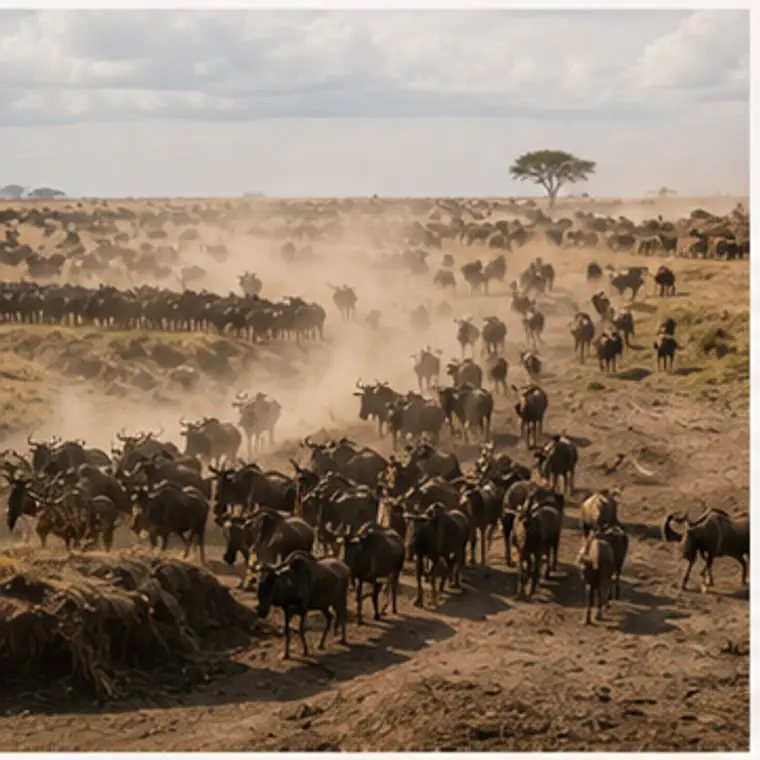
Its defining spectacle is the Great Migration: around two million wildebeest, zebra and gazelle moving in a vast clockwise circuit through the ecosystem, following the rains and the fresh grass. Because the herd is always somewhere, the Serengeti delivers year-round — the trick is matching your dates to the right region.
Where you go matters as much as when. Seronera, the central Serengeti, is the year-round heart of the park, famous for resident lions, leopards in the riverine trees and cheetahs on the open plains — the safest choice if your dates are fixed. Ndutu, on the southern plains, is the calving ground, where the herds gather to give birth from roughly December to March and predator action peaks. The Western Corridor follows the Grumeti River for dramatic crossings broadly between May and July, while the Northern Serengeti and Mara region stage the iconic Mara River crossings from around August to October before the herds turn south again.
Because of its scale, where you sleep in the Serengeti matters as much as when you visit. We cover the timing and camp choices in depth on our dedicated Serengeti guide.
Ngorongoro Crater
The Ngorongoro Crater is the single most extraordinary day of most safaris. It is the world's largest intact volcanic caldera — about 19 kilometres across and some 600 metres deep — formed when a giant volcano collapsed in on itself millions of years ago. The result is a self-contained natural amphitheatre with its own grassland, lake, forest and swamp, ringed by towering walls.
That enclosed bowl holds one of the highest densities of large mammals anywhere in Africa. Almost every iconic species lives here permanently, including a small, closely protected population of roughly 25–30 black rhino — for many visitors the best chance in Tanzania to see this critically endangered animal. Lion, elephant, buffalo, hippo and flamingo are all but guaranteed in a single morning on the crater floor.
What makes Ngorongoro unusual is that it is not a national park but a Conservation Area, where wildlife and people coexist. Maasai pastoralists are permitted to graze their cattle on the surrounding highlands, and you will often see herders sharing the landscape with elephants — a living example of conservation alongside tradition. Daily entry to the conservation area runs at roughly USD 70 per person (2025 reference). One full crater descent is usually enough; a second night nearby lets you take it slowly.
Tarangire National Park
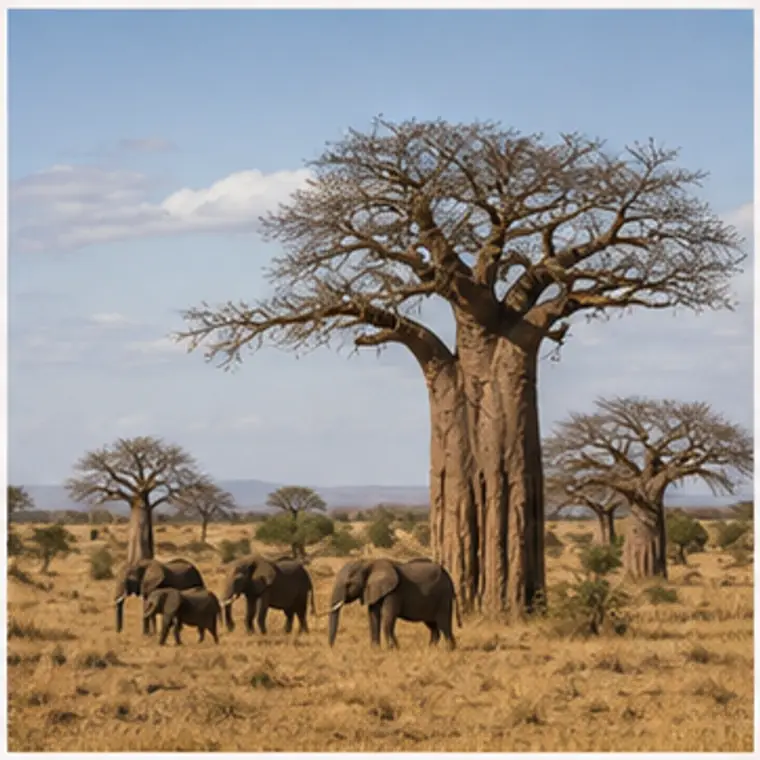
Tarangire is the Northern Circuit's quiet overachiever. Less crowded than its famous neighbours, it offers a completely different landscape — rolling savannah studded with ancient baobab trees, some over a thousand years old, their swollen trunks looking like something from another planet. The Tarangire River winds through the park as a lifeline through the dry months.
The park is best known for its elephants. In the dry season Tarangire holds some of the highest elephant densities in Tanzania, with herds of hundreds gathering along the river — one of the most reliable big-tusker experiences in the country. That seasonal pull is the key to Tarangire: it is strongest from June to October, when the surrounding plains dry out and animals funnel toward the permanent water. Outside the dry season much of the wildlife disperses, so Tarangire earns its place on a dry-season itinerary in particular. One or two nights fit it in perfectly at the start of a trip.
Lake Manyara National Park
Lake Manyara is small, lush and surprisingly varied — a sliver of park squeezed between the dramatic wall of the Great Rift Valley and the shallow soda lake that gives it its name. In a single short drive you pass through groundwater forest alive with baboons and blue monkeys, open floodplain, and the lakeshore itself, where thousands of flamingos can turn the water pink in a good year.
Manyara's signature is its tree-climbing lions, which have a habit of draping themselves over the branches of acacia and sausage trees — behaviour seen in only a handful of places in Africa. Sightings are never guaranteed, but the park's compact size and constant scenery make it rewarding regardless. It works beautifully as a half-day or single overnight on the way between Arusha and the Ngorongoro highlands. Entry is around USD 35 per person (2025 reference), the lowest of the four anchor parks.
The Southern & Western circuits
Beyond the famous north lie Tanzania's wilder, less-travelled parks. They take more effort to reach — usually a flight rather than a drive — but reward you with genuine remoteness and a fraction of the vehicles.
Nyerere National Park (formerly the Selous) is one of the largest protected areas in Africa, defined by the broad, channel-braided Rufiji River. Its standout feature is the boat safari — drifting past hippos, crocodiles and elephants from the water is a completely different rhythm from a game drive — and walking safaris are also a strength here.
Ruaha National Park is Tanzania's largest national park and one of its most remote, a rugged wilderness of baobabs, rocky escarpments and the Great Ruaha River. It holds huge elephant and buffalo populations and one of East Africa's most important lion strongholds, with very few other visitors to share it.
The Southern and Western circuits suit travellers on a second safari, or first-timers who value solitude over ticking off the headline sights. They pair naturally with the beaches of the Tanzanian coast rather than with the northern parks.
How to combine parks
The most common mistake is trying to see everything. More parks means more hours in the vehicle and less time actually watching wildlife. The better approach is to choose two or three parks with complementary characters and a sensible geography.
On the Northern Circuit the classic logic runs in three stages. You ease in on day one or two with a drive from Arusha to Tarangire or Lake Manyara — close by, scenic, and a gentle first taste of a game drive. You then continue up into the Ngorongoro highlands and descend into the crater for a single, wildlife-dense day. Finally you push on into the Serengeti for several nights, positioning yourself in the region where the migration currently is.
Building the route in this order keeps driving times reasonable and saves the most expansive, most memorable park for last. A week covers it without rushing; ten days lets you slow down or add a coastal extension. We tailor every itinerary to your dates and the migration's position rather than forcing a fixed template.
Park fees overview
Park entry fees are charged per person per day and go directly to the authorities that protect these landscapes. They are separate from the cost of your guide, vehicle, fuel, accommodation and meals, all of which sit inside your safari package. The figures below are a 2025 reference; rates are revised periodically, so we confirm the current numbers with every quote.
For a full breakdown of what a complete safari costs — fees, vehicles, camps and the choices that move the price — see our Tanzania safari cost guide, or read the wider Tanzania safari overview first.
| Park | Daily entry fee (2025 reference) |
|---|---|
| Serengeti National Park | ~USD 60 / day |
| Ngorongoro Conservation Area | ~USD 70 / day |
| Tarangire National Park | ~USD 45 / day |
| Lake Manyara National Park | ~USD 35 / day |